
Reading People results
This page explains how to read a results screen after you run a People Intelligence search. The results component is shared across every search type, so this page maps the general Found, Enriched & Connections concept and the Results table reference onto a People search specifically.
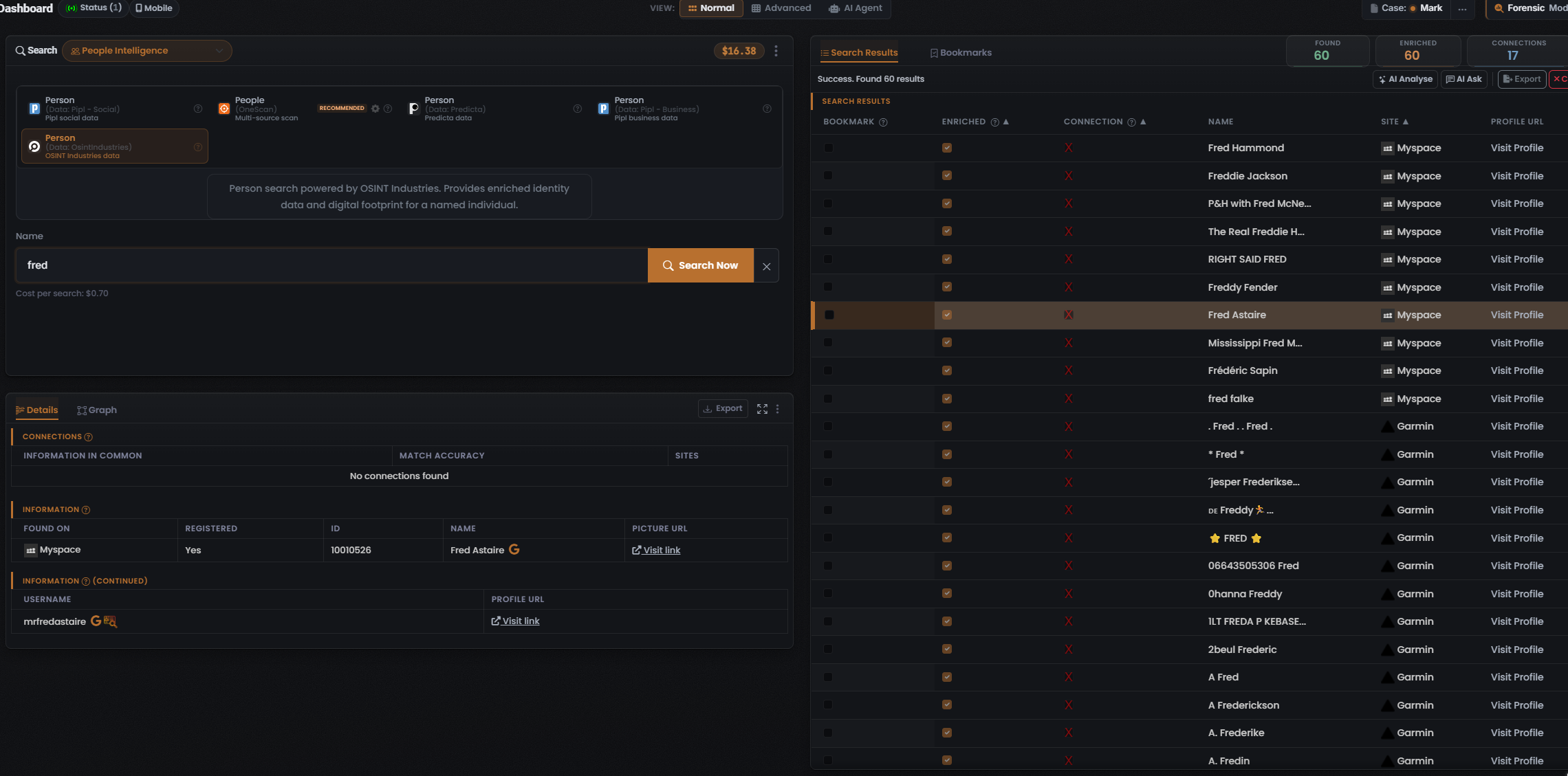
This page’s observed detail comes from one captured run: the Person (Data: OsintIndustries) Module (Cost per search: $0.70), searching the name fred, which returned Found 60 / Enriched 60 / Connections 17.
The three counters
Section titled “The three counters”Every populated results header carries the same trio of counters, always in this order. They count three different things and are never interchangeable — Found is green, Enriched orange, and Connections white:
- Found (green) — the person or identifier was located on a site or data source; a matching result exists there.
- Enriched (orange) — UserSearch holds further metadata on that result (profile-level detail such as possible names, linked emails, and similar). Enriched is a strict subset of Found — only found results can be enriched — and coverage is Module- and data-source-dependent.
- Connections (white) — relationships surfaced between entities, linked-account clusters rather than raw hits. This count can be zero even on a large result set.
Definitions per Lee, 2026-07-08.
In the captured Person (Data: OsintIndustries) run the header read Found 60 / Enriched 60 / Connections 17 — every found result was also enriched (Enriched equals Found), while the Connections counter stood at 17 even though the selected row’s Connections detail read “No connections found” (see the caution below).
The results table
Section titled “The results table”The results panel has Search Results and Bookmarks tabs. A status line (“Success. Found 60 results”) sits above a row of action buttons — AI Analyse, AI Ask, Export, and a red Clear:
- AI Analyse / AI Ask run AI over the result set — see AI Analyse & AI Ask.
- Export downloads the current results — see Export & reports.
- Clear (styled red/coral) empties the current results set.
The table adapts its columns to the Module that produced the results. The captured Person (Data: OsintIndustries) run shows the columns Bookmark · Enriched · Connection · Name · Site · Profile URL:
- Bookmark — a per-row checkbox that saves the result to the Bookmarks tab.
- Enriched and Connection — independent per-row status flags (a check or a red X). In the capture every visible row carried an Enriched check and a Connection red X.
- Name — the display name found for the account (for example Fred Astaire, Freddie Jackson, RIGHT SAID FRED).
- Site — the site the match sits on, shown with its icon; the captured rows span Myspace and Garmin.
- Profile URL — a Visit Profile link that opens the external page.
The Details panel
Section titled “The Details panel”Selecting a row drives the lower-left Details panel. In the captured run it exposes Details and Graph tabs with an Export control, an expand icon, and a three-dot overflow menu; a Profile View tab appears only for certain result types (not present for this result). For the selected Fred Astaire (Myspace) row the Details tab organised the result into labelled sub-sections:
- Connections — columns Information in common · Match Accuracy · Sites; the area read “No connections found” for this row.
- Information — columns Found on · Registered · ID · Name · Picture URL, populated as Myspace · Yes · 10010526 · Fred Astaire · Visit link. The Name value carries a Google “G” pivot icon.
- Information (continued) — columns Username · Profile URL, populated as mrfredastaire · Visit link. The Username value carries both the Google “G” and the magnifier pivot icons.
The Connections sub-section’s Match Accuracy column is set by the third-party data source, not computed by UserSearch (per Lee, 2026-07-08).
Pivoting from a result
Section titled “Pivoting from a result”Small icons sit beside certain returned values, implementing the investigative pivot loop (search → enrich → pivot). In the captured Details panel the Name value carried a “G” icon, and the Username value carried both a “G” and a magnifier icon:
- Google “G” icon — a Google-dork pivot: clicking it opens Google with a preset dork for that value (per Lee, 2026-07-08).
- Magnifier icon — also a Google-dork pivot: like the “G”, it opens a Google dork query for the value (per Lee, 2026-07-10).
See The pivot.
Bookmarks
Section titled “Bookmarks”Switching the results panel to the Bookmarks tab replaces the table with a saved-results list, while the Found / Enriched / Connections counters persist. Each bookmarked row records its term, type, date, and Search type, with a delete action and a View more button to paginate. See Bookmarks.
Verifying a result
Section titled “Verifying a result”- Cross-check Enriched against Found — Enriched should never exceed Found.
- Treat Match Accuracy, where present, as the data source’s own confidence, not a UserSearch computation.
- Weigh the data source behind each row: a person resolved by Pipl, Predicta, or OSINT Industries is a lead from that vendor, not a verified fact. See Data sources & reliability.
- Use the Google “G” or magnifier pivot — both open a Google dork for the value — to corroborate a hit against an independent search before you rely on it.
Related: People search: overview · People modules & options · Found, Enriched & Connections · The pivot · Data sources & reliability
Verified against UserSearch v2.0.20